HomeStoreLogine-LearningBlogCatalogsPress ReleasesTrade ShowsPartnersAbout UsContact Us
English | Français
Share |

ICC Compliance Center Blog


ICC Compliance Center Blog » Transport Canada

Part 4 Dangerous Goods Safety Marks Amendment

by James Henry, CDGT, CET on December 10, 2012 at 8:00 am · in Jim's Blog, Regulations

Transport Canada published in Canada Gazette, Part I, the amendment titled “Part 4 Dangerous Goods Safety Marks”. Notable changes include:

  • introduction of overpacks
  • modifications to the use of the DANGER placard
  • introduction of new safety marks (3)
  • new proposal for placarding large means of containment

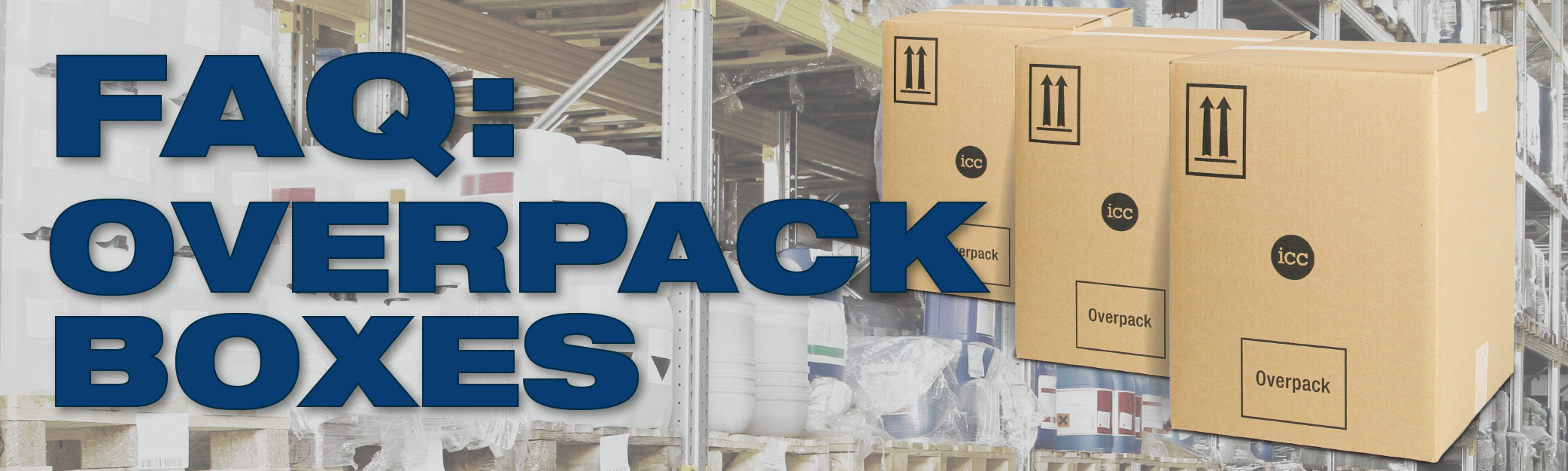
Let’s start with the overpacks. Currently under TDG, overpacks are not recognized although they are being used. And this is causing enforcement issues. TC considers an overpack to be a large means of containment. The definition for overpacks will be added to section 1.4 of TDG. Safety marks for overpacks is covered in section 4.10.1. As part of this section, when the overpack has a capacity ≥ 1.8 m3, then safety marks must appear on two opposite sides of the overpack.

The new safety marks to be introduced are:

All the safety marks are in the UN Model Regulations, ICAO Technical Instructions, IMDG Code and 49 CFR.

The requirements for placards will undergo a major change. The table in TDG section 4.15 is replaced. Placards will be required on both ends and sides of a large means of containment. The subsidiary placard requirements do not change. UN numbers on a placard or orange panel will be required when an ERAP is required, or the dangerous goods are liquids or gases in bulk. IBCs (intermediate bulk containers) will be permitted to only have 2 placards with UN number on opposite sides, or a label and UN number on each side. This will remove the need for equivalency certificates. However, placards with UN numbers will be needed on the outside of the truck.

The use of the DANGER placard changes as well. The DANGER placard can be displayed in place of hazard class placards when there are 2 or more classes and there are 2 or more small means of containment. The current restrictions for the use of the DANGER placard do not change, but those restrictions now include:

  • gross mass not to exceed 1,000 kg,
  • not to include only one hazard class, and
  • are offered by one consignor at one location.

The 500 kg requirement for placards is found in section 4.16.1 with the restrictions being very similar to the restrictions currently found in the exemption 1.16 500 kg gross mass exemption. If any part of a shipment involves a restriction that is listed, then that amount is not used in the calculation for determining placards. For example, if a shipment consists of 2,300 kg of dangerous goods, with 2,000 kg being sodium, then that shipment will require the hazard class placard with UN number as it requires an ERAP. The remaining 300 kg, being under the 500 kg, will not require placards.

The wording of section 4.22.1 for the Category B mark has been changed to read that the Category B mark replaces the Class 6.2 hazard label.

For dangerous goods that are subject to special provision 23, it will now be required to add the words “toxic –  inhalation hazard”  next to the shipping name for small packages, and on the large means of containment, in addition to any required placards.

The purpose of this amendment is harmonize with the international regulations as well as with 49 CFR. There may be additional costs to carriers for implementing these changes, but TC is of the opinion that for carriers who do business in the US, they will already have the additional placard holders on their trucks.

Transport Canada has given 75 days for comment from December 1, 2012. Comments are to be sent to:

Genevieve Sansoucy, Legislation and Regulations, Transport Dangerous Goods Directorate, Department of Transport, Place de Ville, Tower C, 9th Floor, 330 Sparks Street, Ottawa, Ontario K1A 0N5 (tel.: 613-990-5766; fax: 613-993-5925; email: TDGRegulatoryProposal-TMDPropositionReglementaire@tc.gc. ca).

For more information, please go to: http://www.canadagazette.gc.ca/rp-pr/p1/2012/2012-12-01/html/reg2-eng.html

Amendment 11

by James Henry, CDGT, CET on December 7, 2012 at 1:53 pm · in Jim's Blog, Regulations

Transport Canada published Amendment 11 in the Canada Gazette, Part II on December 5, 2012. In Amendment 6 (February 2008), a number of errors were introduced. This amendment corrects those errors, and brings others into line with some changes to the Act (June 2009).

The changes in this amendment are:

  • definition of “person” now aligns with the definition in the Act, including the addition of “organization”,
  • section 1.15 150 kg Gross Mass Exemption has been changed to allow up to 6 aerosols to be transported without complying with Part 5 Means of Containment. However, the aerosols must have a valve protection cap; in addition, special provision 80 has been changed to provide consistency,
  • section 5.5 Filling Limits goes back to the wording prior to Amendment 6 so as to remove any confusion and misinterpretation regarding standards or safety requirements,
  • the placarding provisions of the IMDG Code have been placed in Part 9 Road and Part 10 Rail; this allows for the placarding under the IMDG Code which means that placarding requirements are simpler and will reduce if not eliminate confusion,
  • other changes are of an editorial nature or typo:
    • in section 2.29(2)(c), 0.2 g/L now reads 0.2 mg/L
    • in the restricted paragraphs of section 1.15 and section 1.16, the title for Class 4 has been corrected
    • in section 1.32.1, the shipping name Liquefied Petroleum Gas now reads Liquefied Petroleum Gases
    • table of contents for Part 2 Classification now shows Category A and Category B  instead of risk groups
    • in part 2, appendix 3, item 3, the word “formerlly” is changed to read “formerly”
    • section 1.32.2 Gases, Absolute Pressure between 101.3 kPa and 280 kPa now reads 1.32.2 Class 2, Gases, Absolute Pressure between 101.3 kPa and 280 kPa
    • in section 1.47 UN1044, Fire Extinguishers, Exemption, “and (d)” is added after “Paragraphs 5.10(1)(a)(b)”

Although these changes come into force on December 5, there is a transition period of six months (June 5, 2013) before all the changes become mandatory.

For more information, please see http://www.canadagazette.gc.ca/rp-pr/p2/2012/2012-12-05/html/sor-dors245-eng.html

Vent and Burn

by Suzanne Levac on November 14, 2012 at 1:58 pm · in Suzanne's Blog

Transport Canada and its partners conducted experiments from 2004 to 2006 to further develop an emergency response measure, “the vent and burn technique” for highway tanks, by using commercially available shaped explosive charges. This video presents the results of these experiments. It was produced with the goal to increase awareness of the vent and burn procedure among emergency responders who may be called to an accident scene where other removal techniques cannot be used.
Simply put, ‘Vent and Burn’ is a controlled burn of the contents of a liquefied petroleum gas (lpg) tank truck, rail car or storage tank when no other reasonable options exist. It is a technique of last resort, used to:

  • prevent a catastrophic tank failure;
  • avoid uncontrolled release of propane into the environment; and
  • reduce the time required to handle such an emergency.

The video demonstrates, but does not endorse the vent and burn procedure. It is very dangerous and may not produce results as planned. It should be used only by persons highly trained to assess risk, to assess tank damage and to use explosives.
For more information or to order a DVD (containing the video, a brief summary of the project, and a technical report) please contact the Research, Evaluation and Systems Branch, Transport Dangerous Goods, Transport Canada at TDG-RD-TMD@tc.gc.ca.

Click on link to view video: http://www.tc.gc.ca/eng/tdg/publications-menu-1149.htm
Source: Transport Canada’s website.

Emergency Response Requirements for Shipping Papers

by Karrie Monette-Ishmael on August 1, 2012 at 8:00 am · in Karrie's Blog

What information do you need on a shipping paper or an emergency response situation? Depending on the country you are shipping from, the answer can vary.

Canada

The Transportation of Dangerous Goods Regulations, Part 3, (1) 3.5(f) and (2) outlines the requirements for the shipping document.  These requirements include:

Having the words “24 hour number” followed by an active 10-digit telephone number xxx.xxx.xxxx,

  1. Being able to reach the consignor immediately, and
  2. Providing technical assistance without breaking the connection. An outside agency that is registered with the emergency response provider may be used.

USA

The requirements outlined in the 49 CFR  [172.201(d) and 172.604(b)(1)&/or(2)] states that if the shipper is using an Emergency Response Information provider or an agency on their behalf, a 24-hour telephone number and name of the person or contract number must be added to the Emergency Response Shipping paper.

Recently, an FAA inspector visited a customer of ours and the Emergency Response information on the shipping document was something they checked.  As part of their audit, they called the number listed on the form to verify that the contract number was indeed valid.

Remember, during a transport emergency, first responders rely on this information to react to the situation quickly and to react with the correct protective and fire-fighting measures.

Do you need a 24-hour emergency response service?

24-hour emergency number

ICC has a 24-hour phone number available in the USA, Canada and internationally.

Call us today: USA – 888.442.9628 · Canada 888.977.4834
to get more information or to request a quote.

Shipping Document Bulletin

by Suzanne Levac on July 30, 2012 at 8:00 am · in Announcements, Industry News, Suzanne's Blog

Transport Canada publishes a Bulletin on Dangerous Goods Shipping Document

This Bulletin explains shipping document requirements. It does not change, create, amend or allow deviations from the Transportation Dangerous Goods (TDG) Regulations. Part 3 of the TDG Regulations contains the specific details. A “shipping document” which is defined under section 1.4 of the TDG Regulations is a paper document that contains required information about dangerous goods being handled, offered for transport or transported and identifies the dangerous goods being transported. A shipping document is always required, unless an exemption states otherwise. While you will find most exemptions to the TDG Regulations in Part 1 from sections 1.15 to 1.48, some exemptions appear in Schedule 2. Section 1.17 and special provision 37 in Schedule 2 are examples of when a shipping document is NOT required. To use any exemption, you must follow all the conditions listed, otherwise the TDG Regulations apply. The consignor (the shipper) must complete the shipping document before allowing a carrier to take the dangerous goods.

A truck with many placard holders

The TDG Regulations allow you to prepare shipping documents as set out in other Regulations for international shipments:

  • For international marine shipments, you may complete the shipping document as set out in the International Maritime Dangerous Goods Code (IMDG) Code, and certain requirements from Part 11 (Marine) of the TDG Regulations.
  • For international and domestic air shipments, you must complete the shipping document as set out in the International Civil Aviation Organization (ICAO) Technical Instructions; and
  • For international road or rail shipments from the United States, you may complete the shipping document as set out in the:
    • US Code of Federal Regulations, Title 49. (49 CFR), and
    • Certain requirements from Part 9 (Road) and Part 10 (Rail) of the TDG Regulations
      The bulletin also includes a sample shipping document for most Canadian shipments of dangerous goods

Please follow this link to view the bulletin:
http://www.tc.gc.ca/eng/tdg/publications-bulletin-shipping-documents-1145.htm

Older Posts »

REGULATORY TRAINING | PLANT AUDITS | SDS SERVICES | LABELING SOLUTIONS | TRUCKING PLACARDS & SECURITY SEALS | WORKPLACE SIGNS & TAGS | UN CERTIFIED PACKAGING

Find us on FacebookFollow The Compliance Center on TwitterSubscribe to me on YouTubeVimeoClick here to chat with a live representative
© ICC Compliance Center Inc.