
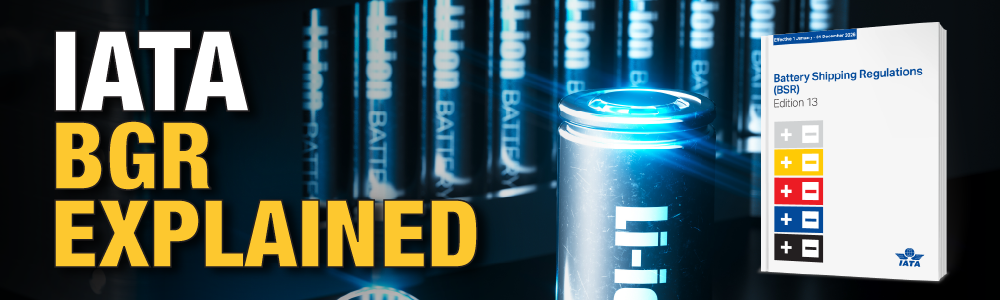
 New 2026 IATA Battery Guidance
As of January 1, 2026, updates aligned with the 67th Edition of the IATA Dangerous Goods Regulations (DGR) are officially in effect. In support of these changes, the International Air Transport Association (IATA) has released updated battery-specific guidance documents (aide-mémoires) focused exclusively on the air transport of sodium-ion and lithium batteries.
These resources are designed to support day-to-day compliance decision-making—but only when applied appropriately and in conjunction with the applicable regulations.
Why This Matters Now
Battery shipments remain one of the most closely scrutinized categories in air transport. Early in each regulatory cycle, maintaining alignment with current guidance helps minimize the risk of shipment delays, rejections, and passenger confiscations.
The 2026 battery guidance documents are intended to support compliance by:
- Clarifying classification pathways for lithium and sodium-ion batteries
- Reinforcing correct packaging, marking, and labeling practices
- Supporting operational checks before cargo is offered for transport
However, it is critical to understand what these documents are—and what they are not.
Guidance vs. Regulations: Knowing the Difference
IATA’s aide-mémoires are practical reference tools, not regulatory substitutes. They are best used for:
- Pre-shipment checks
- Internal training refreshers
- Day-to-day operational validation
They do not replace the IATA Dangerous Goods Regulations, which remain the authoritative sources for compliance.
Who Should Use Which Resource?
To reduce confusion, the guidance documents are best applied as follows:
Shippers and Manufacturers
Use the battery guidance documents to validate classification, packaging instructions, and labeling prior to shipment, then confirm requirements against the full regulations.
Freight Forwarders and Acceptance Staff
Leverage aide-mémoires as a quick reference during acceptance checks, while relying on the DGR or BSR for final compliance determination.
Passengers and Corporate Travel Managers
IATA’s passenger guidance document outlines which batteries may be carried in baggage or on one’s person, helping reduce airport delays and confiscations.
Additional Resources Available
To support compliance across all stakeholder groups, here are some useful resources:
- 13th Edition IATA Battery Shipping Regulations (BSR)
Based on the 67th Edition DGR and effective January 1, 2026 - IATA Passenger Guidance: Traveling with Lithium Batteries
Official guidance for passengers carrying batteries by air - IATA Battery Aide-Mémoire
Battery-specific operational guidance for sodium-ion and lithium batteries
What You Should Do Next
To minimize disruption in early 2026, organizations should:
- Confirm teams are referencing 2026 guidance documents, not prior editions
- Review internal SOPs for battery classification, packaging, and state-of-charge controls
- Ensure staff understand when guidance applies—and when full regulations are required
For a detailed breakdown of what changed in the 13th Edition Battery Shipping Regulations and how those updates impact operations, we recommend reviewing our companion article, What’s New in IATA’s 13th Edition Battery Shipping Regulations.
Staying informed is only the first step. Applying the right resource at the right time is what keeps shipments moving—and compliant.
Stay up to date and sign up for our newsletter!
We have all the products, services and training you need to ensure your staff is properly trained and informed.
 IATA DGR IATA DGR |
 Shipping DG by Air Shipping DG by Air |
 4GV Securepacc 4GV SecurepaccComplete Shipping Kit |