
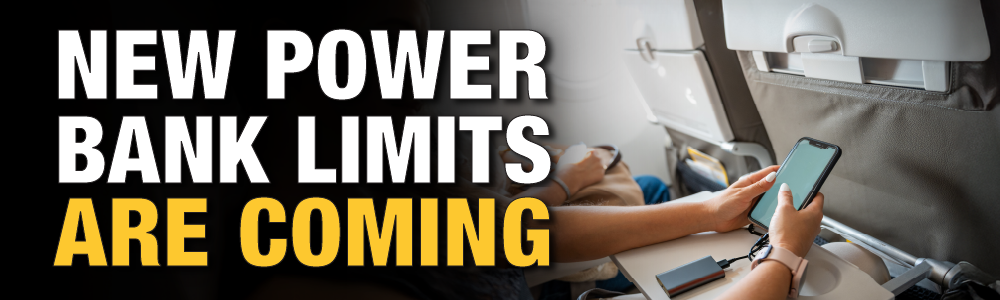
 Addendum Coming Soon: Power Banks
ICAO Panel Recommends New Restrictions
The carriage and use of power banks on aircraft is about to change — and both operators and passengers should be paying close attention.
Following the ICAO Dangerous Goods Panel meeting held in Montreal from October 6–10, 2025, the Panel recommended an amendment to the exceptions for dangerous goods of the operator and provisions for passengers and crew relating specifically to power banks. This amendment is expected to be incorporated into the 2025–2026 edition of the ICAO Technical Instructions through a formal addendum, once ratified by the ICAO Air Navigation Commission (ANC).
If approved, this addendum will introduce more restrictive requirements for power banks carried by passengers.
Proposed ICAO Technical Instructions Wording
The proposed wording to be added to Table 8-1 of the ICAO Technical Instructions (equivalent to IATA Table 2.3.A) is expected to read:
Lithium batteries (including power banks) and portable electronic devices
Power banks:
- Must be carried as carry-on baggage
- Must not be recharged while onboard the aircraft
- Should not be used to recharge a portable electronic device while onboard the aircraft
- No more than two power banks may be carried per passenger
Why This Is a Significant Regulatory Shift
If finalized, this marks a significant tightening of the rules surrounding power banks, particularly the introduction of a numerical limit and explicit restrictions on use and recharging onboard.
IATA Implications and Industry Delays
These provisions are more restrictive than the current requirements in the IATA Dangerous Goods Regulations (67th Edition). As a result, it is expected that IATA will issue its own addendum, along with updates to numerous operator variations, to align with the ICAO changes.
This also explains the delay in publishing the 2026 IATA Lithium Battery Guidance Document. IATA is clearly waiting for the ICAO addendum to be finalized before locking in its own guidance.
One often-overlooked impact of this change is on airside retail operations.
If passengers are limited to no more than two power banks, duty-free and airside shops will need to be informed and prepared. Without controls, passengers could unknowingly purchase multiple power banks after check-in and security screening, placing them immediately out of compliance before boarding even begins.
This will require:
- Updated staff training
- Revised point-of-sale messaging
- Clear coordination between airport authorities, operators, and retailers
Operational and Compliance Challenges
While the intent of the addendum is clearly safety-driven, there is a real-world compliance challenge ahead.
Onboard seat power is not always available — and when it is, it is not always functional. Preventing passengers from using power banks to charge devices will almost certainly lead to non-compliance, not necessarily out of malice, but out of necessity.
Enforcement and Real-World Risk Considerations
There is a strong likelihood that some passengers will continue to use power banks discreetly, for example inside pockets or bags, where overheating, damage, or thermal runaway events are less likely to be detected quickly. From a risk management perspective, this raises important questions about enforcement, passenger education, and realistic safety outcomes.
What Happens Next
The ICAO Air Navigation Commission (ANC) will determine the final wording in the coming weeks. Once ratified:
- An official ICAO addendum will be issued
- IATA will follow with its own addendum and operator variation updates
- Airlines, training providers, ground handlers, and retailers will need to rapidly update procedures, manuals, and passenger communications
Preparing for a Bigger Compliance Topic in 2026
Power banks have long lived in a regulatory grey zone — widely carried, frequently used, and often misunderstood. This upcoming addendum signals a clear shift toward tighter controls, reduced quantities, and limitations on onboard use.
Organizations involved in air transport should start preparing now:
- Review lithium battery and passenger DG policies
- Monitor ICAO and IATA publications closely
- Begin internal discussions with operations, safety, and commercial teams
- Plan for passenger communication strategies that are realistic, clear, and enforceable
More details will follow once the ANC issues the final decision — but one thing is already clear: power banks are about to become a much bigger compliance topic in 2026.
Contact our Regulatory Experts with questions about Addendums or Regulations—we’re here to help. Give us a call at 855.734.5469 or send us an email.
Stay up to date and sign up for our newsletter!
We have all the products, services and training you need to ensure your staff is properly trained and informed.
 IATA DGR IATA DGR |
 Shipping Dangerous Shipping DangerousGoods by Air Training |
 4GV Securepacc 4GV SecurepaccComplete Shipping Kit |


 ICC USA
 ICC Canada