
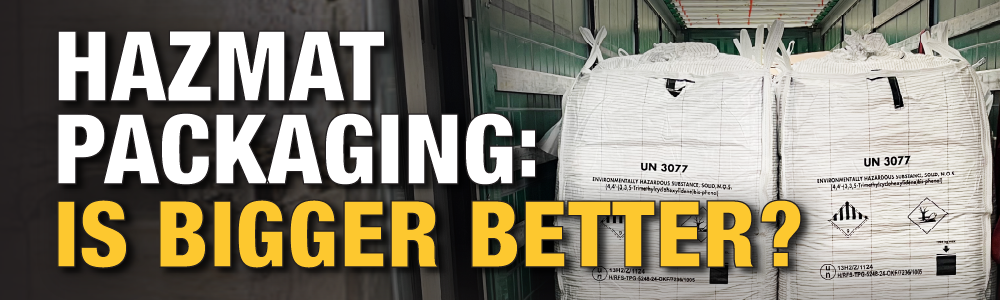
 Large Packagings for Hazardous Materials
Introduction: A New Option in Hazmat Packaging
When most people think about hazardous materials packaging, they picture either “non-bulk” packaging such as drums, cartons or cylinders, or “bulk” packaging, such intermediate bulk containers (IBCs), tank trucks or railway tank cars. But there’s another type of packaging making its way onto the market, called “large packagings.” These specialized containers offer both safety and efficiency in the transport of hazardous materials, but shippers and carriers should become familiar with them and how they work.
What Are Large Packagings, and Why Are We Seeing Them Now?
Under both the “Hazardous Materials Regulations” in Title 49 of the Code of Regulations (49 CFR) and international rules such as the UN Model Regulations, large packagings are defined as containers with a capacity greater than 450 liters (about 119 gallons), but not exceeding 3,000 liters (793 gallons). This would seem to make them equivalent to intermediate bulk containers (IBCs). But the difference that “bulk” containers aren’t meant to have inner containers, while “large packagings” are designed to hold inner packagings. In a sense, they’re a hybrid between a non-bulk combination packaging and an IBC. Or just think of them as overgrown combination packagings that exceed the normal 450 liter limit for those packagings. Essentially, a large packaging is a bigger outer box, drum, or cage-type container that safely consolidates smaller containers of hazardous materials for easier handling and transport.
Regulatory Background and Adoption
Large packagings were first introduced in the UN Recommendations on the Transport of Dangerous Goods (the UN Model Regulations), appearing officially in the 9th revised edition in 1995. The regulators intended to create a packaging option that sat between smaller combination packagings (like boxes containing bottles or cans) and intermediate bulk containers (IBCs). Large packagings were designed to consolidate multiple inner packagings, while IBCs are meant to directly contain the substance itself.
Following their inclusion in the UN Model Regulations, countries and modal regulations gradually adopted them. In the U.S., for example, the DOT incorporated large packagings into the “Hazardous Materials Regulations” in the late 1990s, aligning with international standards. However, large packagings didn’t seem to have much of an impact at first in North America. But they have become much more common internationally and are making their way into the United States and Canada.
What Are Common Types of Large Packagings?
Large packagings have to have strong outer containers, since their weights are typically higher than normal non-bulk packages. They can come as:
- Rigid large packagings: Often made of steel, aluminum, wood or rigid plastics, these provide high durability and resistance to impact.
- Flexible large packagings: Typically constructed of heavy-duty woven plastics with lifting straps, these resemble large industrial bulk bags.
- Composite large packagings: A combination of rigid and flexible materials, providing both structure and containment.
Understanding UN Specification Codes
UN specification codes for large packagings start with “50” for rigid outer packaging or “51” for flexible large packagings, followed by the material of construction and other relevant details. The code specifies the packaging type (for example, drum or box) and material (such as steel or plastic), with letters and numbers indicating construction and design features. For example, a large packaging made of plastic would be marked as 50H, while one made of plywood would be marked as 50D.
Benefits of Using Large Packagings
Why would you use a large packaging? They have a number of advantages in certain situations, including:
- Handling Efficiency: Instead of moving multiple small cartons or pails, shippers can consolidate them into a single large unit.
- Reduced Risk of Damage: Inner packagings are protected by the sturdier external large packaging, lowering the chance of leaks or spills. On the other hand, inner containers within a large outer packaging are less likely to result in total product loss compared to IBCs if the outer container is breached.
- Compatibility with Mechanical Handling: Large packagings are designed to be moved with forklifts or pallet jacks. This speeds up loading and offloading and improves workplace safety by limiting manual handling risks.
Use of Large Packagings
While large packagings can be useful in many situations, they aren’t always suitable. First, large packagings have been accepted by most regulations such as the International Maritime Dangerous Goods (IMDG) Code and 49 CFR, but not all.
One exception is Canada. Under the “Transportation of Dangerous Goods Regulations” (TDGR), large packagings are not yet recognized (note that the term “large means of containment” in the TDGR does not have the same meaning as “large packagings,” and currently refers to what 49 CFR calls bulk packaging). There is a standard ready to cover them, CGSB-43.145-2019, but this has not yet been recognized in the actual regulations. Transport Canada has indicated that the standard will be authorized in the upcoming Regulations Amending Certain Regulations Made Under the Transportation of Dangerous Goods Act, 1992 (Part 12 and International Harmonization Update).
Contact us today to find the safest, most efficient packaging solution.
Our Regulatory Experts are always happy to help – send us an email today!
Stay up to date and sign up for our newsletter!
We have all the products, services and training you need to ensure your staff is properly trained and informed.
 Bill of Lading Forms Bill of Lading Forms |
 Placards Placards |




 ICC USA
 ICC Canada