
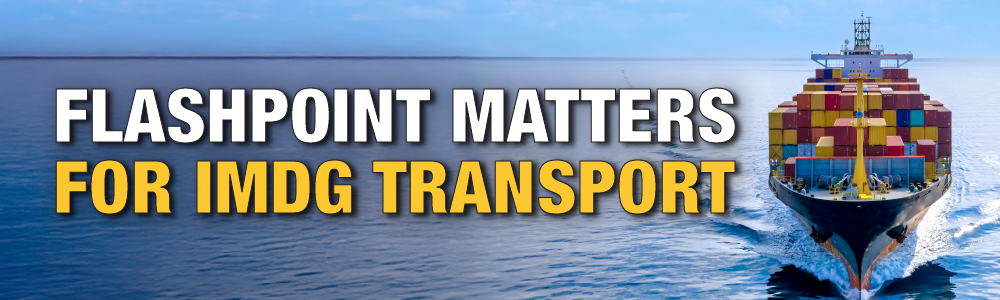
Why Flashpoint Matters in Marine Shipping
If you ship internationally by ocean, you should be familiar with the requirements of the International Maritime Dangerous Goods Code (IMDG). While this is similar to other regulations such as the “Hazardous Materials Regulations” (HMR) found in Title 49 of the Code of Federal Regulations (49 CFR), the Code has a few variations that address specific problems encountered in shipment by vessel.
For example, when we come to shipping papers, or what the IMDG calls the “transport document,” there are a number of extra pieces of information listed in section 5.4.1.4.3, Most of them are similar to special documentation requirements found in 49 CFR or Canada’s “Transportation of Dangerous Goods Regulations” (TDGR), for situations such as the addition of technical names to generic shipping names, or identifying elevated temperature materials. But section 5.4.1.4.3.7 is an important one for marine shippers:
“Flashpoint: If the liquid dangerous goods to be transported have a primary or subsidiary hazard of class 3 and a flashpoint of 60°C or below (in °C closed-cup (c.c.)), the minimum flashpoint shall be indicated. Because of the presence of impurities, the flashpoint may be lower or higher than the reference temperature indicated in the Dangerous Goods List for the substance.”
This can be a problem for the shipper. For ground shipment, you normally do not have to do this. If you do your paperwork by computer, do you find a way to flag which shipments are being transported under the IMDG Code? Do you put the flashpoint on all documents, ocean and ground? Is your system granular enough that if, say, you have twenty types of UN1263, Paint, Class 3, you can put a different flashpoint on each one? It’s a big headache for many organizations. So why do we have to do it in the first place?
What’s a Flashpoint?
First of all, what is a flashpoint? The IMDG defines it as:
“Flashpoint means the lowest temperature of a liquid at which its vapour forms an ignitable mixture with air.”
Essentially, it means that if the liquid spills or is released on board the ship, the flashpoint is the lowest temperature at which the vapours can ignite on contact with an ignition source and cause a flash fire, or even an explosion. Such fires can be devastating at sea, so knowing the flashpoint can be vital in protecting the vessel from fire damage.
Note that the IMDG Code does make a distinction between “closed cup” flashpoint data (which it identifies with the abbreviation “c.c.”) and “open cup.” Open cup testing usually gives a value a few degrees above closed cup testing, which should be taken into account for classification of flammable liquids.
Why Does the Flashpoint Matter for Vessel Transport?
The IMDG Code and other regulations require listing the flashpoint for flammable liquids (Class 3) transported by sea because this information can be crucial for assessing the risk of fire or explosion and ensuring proper handling and safety measures. In order to prevent fires involving flammable liquids, regulations such as the IMDG Code and 49 CFR have specific rules about handling and stowage of such substances. For example, in IMDG section 7.6.2.2.1, it states:
“In cargo ships of 500 gross tons or over and passenger ships … flammable gases or flammable liquids having a flashpoint of less than 23°C c.c, shall be stowed on deck only, unless otherwise approved by the Administration.”
There are provisions for older ships to carry flammable liquids below deck, but there are specific ventilation requirements for the holds in that case. Additionally, low-flashpoint liquids must be stowed at least three meters from any potential source of ignition, such as open flames or electrical outlets.
The problem is that the current classification scheme for flammable liquids in the IMDG Code and other regulations doesn’t specify by the class if the flashpoint is over or under 23°C. They’re all just put into class 3. You might be able to establish the probable flashpoint from the packing group – most liquids in packing group II have flashpoints less than 23°C closed cup – but there are a number of exceptions to this rule.
So, in order to know for sure if the liquid is subject to the restrictions on stowage and segregation, the carrier must know the exact flashpoint. This is why section 5.4.1.4.3.7 requires the actual flashpoint (or, if applicable, the flashpoint given for a pure substance as given in the Dangerous Goods List, Column 17) must be added to the shipping description on the transport document under the IMDG Code.
National regulations may also come into play when planning a vessel shipment of flammable liquids. For example, 49 CFR 183.306(c)(1) sets ventilation requirements for stowage of non-bulk packages in vessel holds based on the flashpoint.
Note that while Canada’s TDGR do not mention specific requirements regarding stowage or segregation of flammable liquids, section 3.6(1)(3)(a)(i) requires that the flashpoint for class 3 flammable liquids to be included on the shipping document whenever transporting by vessel.
Remember, of course, that the best place to find the flashpoint of a flammable liquid is the Safety Data Sheet (SDS). That is, of course, if the manufacturer has already done the testing. If you’re the manufacturer you’ll have to find a laboratory that can do the test, but the good news is it’s relatively simple and inexpensive, as chemical testing goes. As a shortcut, you can check Column 17 in the IMDG Code’s Dangerous Goods List, where it’s often provided for pure substances, although not for variable products such as mixtures.
Conclusion
Having to add the flash point to the transport document for marine shipment can be inconvenient at times, but there are good reasons for the requirement. Stowage of flammable liquids on a ship can be much more complex than on a road or rail vehicle, and the flashpoint can be a critical part of figuring out the safest method.
Do you have questions about shipping documents, or need a computerized system for creating your own? Just contact ICC Compliance Center 1-888-442-9628 (U.S.) or 1-888-977-4834 (Canada) for advice and products that can help.
Stay up to date and sign up for our newsletter!
We have all the products, services and training you need to ensure your staff is properly trained and informed.
 Shipping Dangerous Shipping DangerousGoods by Sea |
 4GV Securepacc™ 4GV Securepacc™Complete Shipping Kits |
References:
U.S. Department of Transportation, Title 49 of the Code of Federal Regulations (49 CFR), “Hazardous Materials Regulations,” https://www.ecfr.gov/current/title-49/subtitle-B/chapter-I/subchapter-C
International Maritime Organization, The International Maritime Dangerous Goods Code (IMDG)
Kallada, Shashi, “Stowage and Segregation of Dangerous Goods on General Cargo Ships”
Kallada, Shashi, “Class 3 Flammable Liquids”
Kherkher, Steve, “Why are Container Ship Fires a Major Concern?”



 ICC USA
 ICC Canada