
Frequently Asked Packaging Questions

When is UN-certified packaging legally required?

UN-certified packaging is generally required under U.S. DOT (49 CFR), as well as TDG (Canada), IATA (air), and IMDG (sea) regulations when shipping dangerous goods above applicable limited quantity or excepted quantity exemptions.

The specific requirement is triggered when a packing instruction (IATA/IMDG) or packaging section (49 CFR/TDG) explicitly mandates UN specification packaging for a given UN number, hazard class, and packing group.

How ICC can help:

👉 Browse our wide variety of Packaging | More FAQs

What documentation must accompany compliant hazardous materials packaging?

Under U.S. DOT (49 CFR), shipments require shipping papers, similarly, TDG and IMDG Code require shipping documents as well. IATA (air) requires a Shipper's Declaration for Dangerous Goods.

The documentation must align with the packaging and include:

  • Proper shipping name, UN number, hazard class, and packing group
  • Quantity and type of packaging
  • Emergency response information

How ICC can help:

  • Products: Shipping forms for all modes of transport.

👉

Learn more with our Documentation FAQ.

How do regulatory changes affect existing packaging inventories?

Regulatory changes (U.S. DOT → TDG → IATA/IMDG) typically include transition periods, allowing companies to continue using existing packaging for a defined timeframe.

However, continued use depends on whether:

  • The packaging still meets updated performance standards
  • The marking and certification remain valid
  • The packaging is still authorized for the material under revised rules

👉

Read some of our articles:

How do you determine the correct UN packaging for a specific material?

The correct packaging is determined using the applicable U.S. DOT (49 CFR) packaging section or IATA/IMDG packing instruction, based on:

  • UN number and proper shipping name
  • Hazard class/division
  • Packing group (I, II, III)
  • Quantity and mode of transport

For combination packaging, both inner and outer packaging types are specified.

How ICC can help:

👉

Browse our wide variety of Packaging | More FAQs.

What are the risks of reusing UN-rated packaging?

Reusing UN packaging introduces risk if the packaging can no longer meet UN performance standards required under U.S. DOT, TDG, IATA, and IMDG.

Key risks include:

  • Structural degradation from prior use (impact, stacking, vibration)
  • Compromised closures (e.g., weakened fiberboard from tape removal on 4G boxes)
  • Unknown handling history
  • Failure to meet capabilities to pass drop, stack, vibration, or leakproofness tests

This can result in shipment rejections, fines, or safety incidents.

👉

Shop UN Boxes & Packaging.

👉

Read more: Can I Reuse UN Standard Packaging?

Still have questions? Ask an Expert!

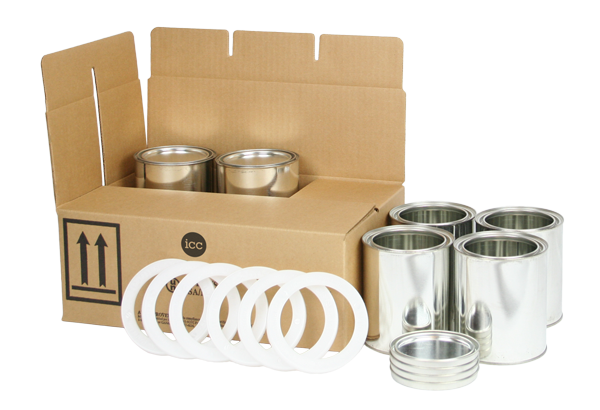
4G UN Quart Can Shipping Kit – 6 x 1 Quart (with cans)

$116.28

Kit Capacity: 6 x 1 quart (5.68 litres)  |  Max Box Weight: 23.1lbs/10.5kg
Box Inner Dimensions: 14″ x 9.44″ x 5.13″  |  4G Shipping Kit
Transport: PG II,III, Liquid  |  UN Rating: 4G/Y10.5/S
Complies with: IATA, DOT 49 CFR, IMDG, ICAO, TDG Regulations, UPS & FedEx requirements

Price Tab

Product Code: PK-N6QTCN
Qty.Discount %Price Per
100-24910%$104.65
250-49919%$94.19
500+27%$84.88

Description

  • Quart can shipping kit
  • Suitable for Packing Group II & III, Liquids
  • Complies with: IATA (6.3), DOT 49 CFR (178.600), IMDG (6.1.5), TDG (TP14850 Part 1) & UN Model (6.1.5)
  • Meets UPS & FedEx Hazardous Materials/Dangerous Goods packaging requirements

Details for 4G UN Quart Can Shipping Kit

  • Fibreboard Box Inner Dimensions: 14″ x 9.44″ x 5.13″ | 35.6 x 24 x 13 cm
  • 4G Test Configuration: 6 x 1 quart cans
  • Capacity: 6 quarts
  • Maximum Gross Weight: 23.1lbs/10.5kg
  • Components included: Outer box, Cans with lids, Ringloks
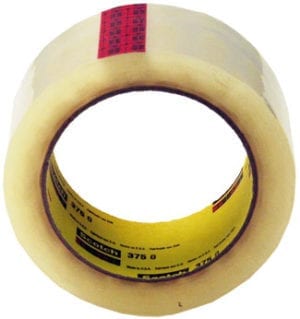
  • Components required: 3M #375 48mm clear tape
  • UN Rating: 4G/Y10.5/S
  • Bursting Strength: Die Cut 275C

Benefits of our Gallon Can Shipping Kits

  • Complete kit – no additional absorbent materials required
  • Includes Box, Cans, Lids, Ringloks
  • Clean – no messy vermiculite required

ICC Compatible Products

** For air shipment of liquids, inner containers must meet pressure, secondary closure, and leak-proof liner requirements (See IATA DGR Section 5 / ICAO TI Section 4 / US 49 CFR 173.27).

Packing Instructions are required for this product. Download the required packing instruction here.
For Box Certificates, click here to download.
Additional information

Weight 2.9 lbs
Dimensions 14 × 9.44 × 5.13 in
Bursting Strength

Dimensions

Maximum Gross Weight

Priced Per

Quantity of Inner Containers

UN Specifications

Volume

Frequently Asked Packaging Questions

When is UN-certified packaging legally required?

UN-certified packaging is generally required under U.S. DOT (49 CFR), as well as TDG (Canada), IATA (air), and IMDG (sea) regulations when shipping dangerous goods above applicable limited quantity or excepted quantity exemptions.

The specific requirement is triggered when a packing instruction (IATA/IMDG) or packaging section (49 CFR/TDG) explicitly mandates UN specification packaging for a given UN number, hazard class, and packing group.

How ICC can help:

👉 Browse our wide variety of Packaging | More FAQs

What documentation must accompany compliant hazardous materials packaging?

Under U.S. DOT (49 CFR), shipments require shipping papers, similarly, TDG and IMDG Code require shipping documents as well. IATA (air) requires a Shipper's Declaration for Dangerous Goods.

The documentation must align with the packaging and include:

  • Proper shipping name, UN number, hazard class, and packing group
  • Quantity and type of packaging
  • Emergency response information

How ICC can help:

  • Products: Shipping forms for all modes of transport.

👉

Learn more with our Documentation FAQ.

How do regulatory changes affect existing packaging inventories?

Regulatory changes (U.S. DOT → TDG → IATA/IMDG) typically include transition periods, allowing companies to continue using existing packaging for a defined timeframe.

However, continued use depends on whether:

  • The packaging still meets updated performance standards
  • The marking and certification remain valid
  • The packaging is still authorized for the material under revised rules

👉

Read some of our articles:

How do you determine the correct UN packaging for a specific material?

The correct packaging is determined using the applicable U.S. DOT (49 CFR) packaging section or IATA/IMDG packing instruction, based on:

  • UN number and proper shipping name
  • Hazard class/division
  • Packing group (I, II, III)
  • Quantity and mode of transport

For combination packaging, both inner and outer packaging types are specified.

How ICC can help:

👉

Browse our wide variety of Packaging | More FAQs.

What are the risks of reusing UN-rated packaging?

Reusing UN packaging introduces risk if the packaging can no longer meet UN performance standards required under U.S. DOT, TDG, IATA, and IMDG.

Key risks include:

  • Structural degradation from prior use (impact, stacking, vibration)
  • Compromised closures (e.g., weakened fiberboard from tape removal on 4G boxes)
  • Unknown handling history
  • Failure to meet capabilities to pass drop, stack, vibration, or leakproofness tests

This can result in shipment rejections, fines, or safety incidents.

👉

Shop UN Boxes & Packaging.

👉

Read more: Can I Reuse UN Standard Packaging?

Still have questions? Ask an Expert!

You may also like…