
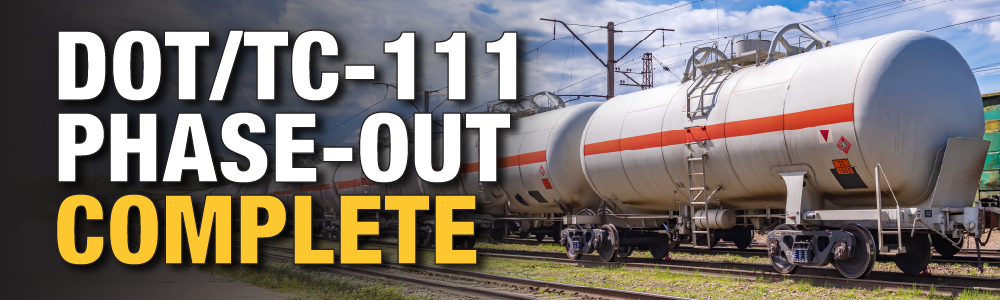
 U.S. and Canada Complete DOT-111 Phase-Out
The DOT-111 tank car (known as the TC-111 tank car in Canada) has long been the workhorse of the North American rail system. Their size (maximum capacity of around 34,500 U.S. gallons or 131,000 Litres) and economical construction made them a great choice for general purpose transport of liquids. This has traditionally included flammable liquids in Class 3 and combustible liquids (those with flash points above 60°C up to 93.3°C.)
However, a number of serious accidents have highlighted their design limitations and poor crash performance. This led both Canada and the United States to mandate their phase-out, replacing them with higher-standard tank cars developed under harmonized North American regulations.
Safety Deficiencies of DOT-111 Tank Cars
The phase-out stems from well-documented design weaknesses. Studies by the National Transportation Safety Board (NTSB) and the Transportation Safety Board of Canada (TSB) found some significant safety issues when using DOT-111 cars for hazardous material transport. These include:
- Thin outer shells — typically, DOT-111 cars have shells that are 7/16-inch steel without additional reinforcement, making them prone to puncture in derailments.
- No head shields — this leaves the ends of the tank exposed to impact damage.
- Minimal thermal protection — with no jackets or thermal blankets in most cases, DOT-111 cars are subject to catastrophic rupture in pool fires.
- Vulnerable bottom outlets — these outlets make loading and unloading easier, but can shear off during derailments, causing uncontrolled product releases.
These deficiencies result in a high probability of release with DOT-111 cars. While the results of a release of non-hazardous materials may not be all that serious, ruptures and subsequent fires involving flammable or combustible liquids can be catastrophic. This can be reduced somewhat if the tank car is “jacketed” (that is, has an extra outer steel “jacket” wrapped around the tank shell), but in general the use of DOT-111/TC-111 cars is a concern if the contents are hazardous.
The Regulatory Catalyst: Lac-Mégantic and Beyond
DOT-111 cars were already under scrutiny when one of the worst-ever hazmat-release rail accidents occurred in the province of Québec. On July 6, 2013, the small town of Lac-Mégantic was devastated when a train carrying light crude oil derailed in the town center. The oil was released from about 63 DOT-111 cars, turning the accident scene into an inferno. Forty-seven people died, and the downtown core was destroyed. The catastrophic rupture of multiple DOT-111 cars intensified the fire and destruction.
Other derailments in Aliceville, Alabama (2013), Casselton, North Dakota (2013), and Gogama, Ontario (2015) underscored the risk of continuing to use these cars for flammable cargo.
Canadian and U.S. Regulatory Responses
Following these events, Transport Canada and the U.S. Department of Transportation coordinated to improve tank car standards through harmonized rules.
- Canada:
- Transport Canada ordered the phase-out of the least-protected DOT/TC-111s in April 2014.
- By November 1, 2016, unjacketed DOT/TC-111s were banned from transporting crude oil.
- A full phase-out of DOT/TC-111s and CPC-1232s (an interim improved design used before the approval of the DOT/TC-117 standard) for flammable liquids followed, with deadlines accelerated to align with U.S. standards.
- All DOT/TC-111s were banned from transport of flammable liquids as of May 1, 2025.
- United States:
- The Pipeline and Hazardous Materials Safety Administration (PHMSA) and the Federal Railroad Administration (FRA) issued the “Enhanced Tank Car Standards and Operational Controls for High-Hazard Flammable Trains” rule in May 2015 (HM-251; 49 CFR Parts 171–180).
- This required replacement of DOT-111s with DOT-117 cars (or retrofitted DOT-117R).
- Phase-out deadlines vary by commodity, but the last compliance dates were reached mostly by May 1, 2025, with a hold-out for moderately to mildly flammable liquids (if they are not unrefined crude oil or ethanol) until May 1, 2029.
Phase-Out Timetable
Note that although Canada’s schedule was more aggressive early on, particularly for unjacketed DOT-111s in crude and ethanol service, the U.S. and Canadian deadlines converged by May 1, 2025, when all DOT-111s and CPC-1232s were to be removed from flammable liquid service unless retrofitted to DOT-117/TC-117 standards.
The U.S. maintains one exception that will be allowed for domestic transport. Flammable liquids that are not crude oil or ethanol may be shipped in DOT-111 tank cars until May 1, 2029.
Here is the DOT phaseout schedule. Note that for flammable liquids in packing groups II or III, the DOT-111 cars may still be used if the liquids are not unrefined petroleum products or ethanol. However, shipments like this would not be accepted into Canada.
DOT Phaseout Schedule
| Material | Jacketed or non-jacketed tank car | DOT-111 not authorized on or after | CPC-1232 not authorized on or after |
| Unrefined petroleum product | Non-jacketed | January 1, 2018 | April 1, 2020 |
| Jacketed | March 1, 2018 | May 1, 2025 | |
| Ethanol | Non-jacketed | May 1, 2023 | May 1, 2023 |
| Jacketed | May 1, 2023 | May 1, 2025 | |
| Class 3, PG I (flammable liquid) material other than unrefined petroleum products and ethanol | Non-jacketed | May 1, 2025 | May 1, 2025 |
| Jacketed | May 1, 2025 | May 1, 2025 | |
| Class 3, PG II or III (flammable liquid) material other than unrefined petroleum products and ethanol | Non-jacketed | May 1, 2029 | May 1, 2029 |
| Jacketed | May 1, 2029 | May 1, 2029 |
The Replacement Standard: DOT-117 / TC-117
The DOT-117 (U.S.) and TC-117 (Canada) standards address the vulnerabilities of DOT-111s by introducing a number of improvements to the strength and safety of the cars. These include:
- Increasing the shell thickness to 9/16-inch steel
- Mandating full-height head shields
- Providing better thermal protection systems (insulation and jackets with ceramic blankets)
- Requiring high-capacity pressure relief devices
- Designing protection for top fittings to prevent shearing
- Improving the bottom outlet handles to resist failure
Retrofit standards (DOT-117R / TC-117R) allow the upgrading of certain CPC-1232 and DOT-111 cars with equivalent protections. Of course, the DOT/TC-111 tank cars may remain in service for non-flammable cargoes.
Conclusion
The phase-out of DOT-111 tank cars reflects the saying that safety recommendations are often written in blood. The commitment made by the U.S. and Canada to ensuring safer tank cars for flammable liquids can help make all our communities safer. And by harmonizing the phase-out from DOT/TC-111 cars to DOT/TC-117, we ensure that North American shipments are kept as simple as possible.
Need Help with Compliance?
Do you have any questions about packaging standards for hazardous chemicals in either Canada or the United States? If you’d like more information, contact ICC Compliance Center at 888-442-9628 (U.S.) or 888-977-4834 (Canada), and ask for one of our Regulatory Experts or send us an email, we’re happy to help. We can advise you how to comply with current and upcoming regulations.
Stay up to date and sign up for our newsletter!
We have all the products, services, and training you need to ensure your staff is properly trained and informed.
 Glass Shipping Kits Glass Shipping Kits |
 TDG Publications TDG Publications |
 Worded Placards Worded Placards |



 ICC USA
 ICC Canada