
Description
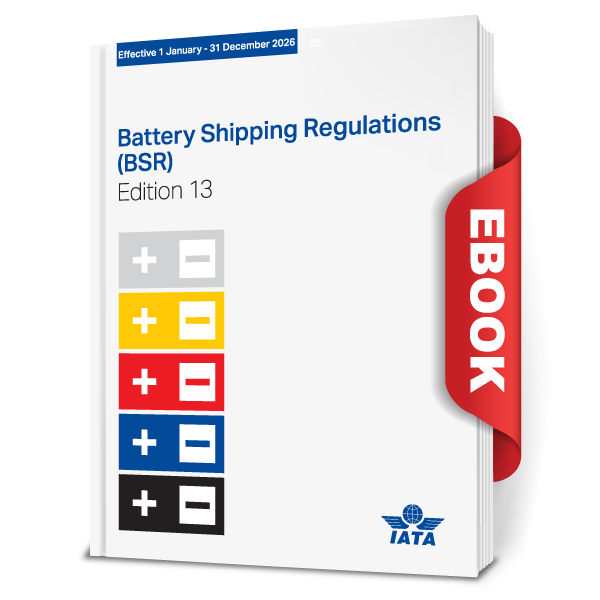
Battery Shipping Regulations (BSR)
As adoption of electric cars, e-bikes increase and lithium batteries become lighter and last longer, the number of products relying on lithium batteries will only continue to grow.
Though a practical and efficient way to store energy, lithium batteries, if not properly designed, tested and manufactured can fail and catch fire. In addition, the stored energy and flammable electrolyte in the battery means that they must be prepared properly for shipping to reduce the potential risk to the transport system.
To help address this, IATA put together the BSR; a manual with all the information manufacturers, retailers, wholesalers, freight forwarders and others in the supply chain need to ensure compliance when shipping lithium batteries.
Significant Changes and Amendments to the 13th edition (2026) of the Battery Shipping Regulations (BSR) include:
- Amendment of section 4.2: List of dangerous goods to include new entries for battery-powered vehicles, including hybrids, which appear in light text, to give air carriers and operators clearer guidance to assess risks associated with transporting hybrid vehicles.
- Revision to indicate that lithium ion cells and batteries which are packed with equipment, must now be offered at a state of charge not exceeding 30% of their rated capacity, or an indicated battery capacity not exceeding 25%, with specific provisions for State Approvals.
- Inclusion of packaging, marking and labeling, and documentation examples for batteries contained in and packed with equipment, All Packed in One outer packaging.
- Inclusion of an aide memoire for ELI and ELM batteries to help shippers perform their own checks for compliance before offering batteries for transport by air.
- New and improved battery classification tool in the BSR digital format, featuring sodium ion battery classification, to help shippers determine the correct classification for different battery chemistries and configurations including those contained in and packed with equipment.
- Introduction of a definition for Safety Data Sheet and inclusion of additional text regarding the context, purpose and rationale of Safety Data Sheets.
What’s inside the BSR?
Making a mistake with marking, labelling or packaging products with lithium batteries can at best cause delays. At worst, the battery could fail or short circuit causing a fire. The BSR covers all aspects of the shipping process from packaging requirements, labelling, marking and what to do if something goes wrong en route.
- Applicability (definitions, shipper responsibilities, caution, training, dangerous good security)
- Regulations (international legislation, dangerous goods carried by passengers, variations by state and operator, UN Manual of Tests and Criteria, subsection 38.3 )
- Classification (UN Numbers, Class 9 substances, classification scenarios, testing)
- Identification (list of dangerous goods, special provisions)
- Packing (combination packaging, quantity limits, UN specifications, overpacks, instructions, examples)
- UN specification packaging performance tests (test frequency, drop test, stacking test, reports, suppliers)
- Marking and labelling (marks, specifications, shipper’s responsibilities, examples)
- Documentation (declaration form instructions and examples, waybills,)
- Acceptance (checklists, refusals)
- Emergency response
This publication is compliant from January 1, 2026 to December 31, 2026.
This IATA publication is made available in an e-Reader solution called Bookshelf. Bookshelf Online is accessed through a browser. The publication can also be accessed with the Bookshelf software application, installed on a computer or tablet.
Features & Benefits
Online:
– Can be used in popular browsers
– No software to install
Offline:
– There’s an app (Bookshelf, from company VitalSource) for all popular platforms
– No internet connection required after downloading your titles
Common:
– Searchable text
– Content adjusts to screen size
– Table of contents
– Bookmarks, notes & highlighting
– Resource files (i.e. excel files, forms, power points, PDF extracts) that are down-loadable, printable and fillable
– Intra-document hyperlinks
Accessing your Digital IATA BSR in 2 easy steps:
- Redeem Code: Within 2 business days after online purchase, you will receive an email with a redeem code to access your publication.
- Bookshelf Account: Create online bookshelf account. Once you in your account click on the “Redeem Code” link and enter the redeem code provided to you in the email (Important: Redeem codes can only be redeemed once).


 ICC USA
 ICC Canada