
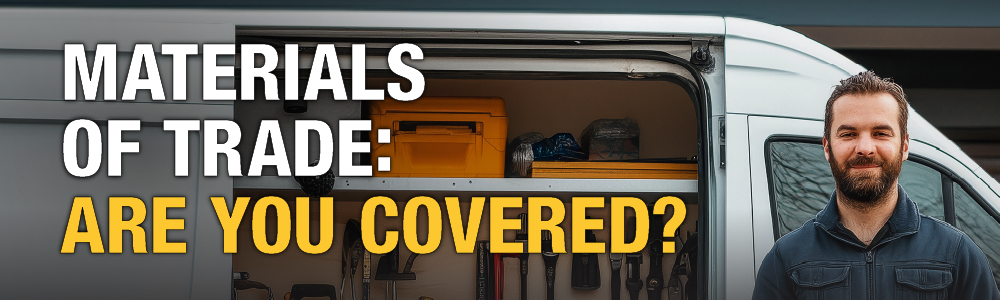
Know Your Exemptions – Materials of Trade
The “Hazardous Materials Regulations” (HMR), found in Title 49 of the Code of Federal Regulations (49 CFR), were originally conceived with a simple framework – a shipper, usually a vendor, sends a consignment of the hazardous materials by a carrier to a receiver, who is usually a purchaser. But not all transport of hazardous materials follow this pattern.
For example, take Frank, an independent contractor. He runs a small but busy plumbing business. Every morning, Frank loads up his work truck with equipment and supplies he’ll need for the day’s work. Some of those supplies include dangerous chemicals and articles. They could include materials such as primers and adhesives, a bottle of propane for his blowtorch, corrosive drain cleaners and biocides used to kill mold.
Now, all of these materials are technically considered hazardous under U.S. Department of Transportation (DOT) regulations. But these goods aren’t cargo for delivery. Frank isn’t in the business of transporting hazardous cargo—he just needs these supplies to do his job. Having to comply with the requirements of the HMR, such as special packaging, labeling and placarding, special documentation and training certification would be a significant burden for Frank in time and money. But fortunately, the regulations give Frank a break. Businesses and individuals who transport reasonable amounts of hazardous materials for their own use as part of their line of work may qualify for an important exception known as Materials of Trade (MOT).
What is the Materials of Trade Provision?
The Materials of Trade provision is found in section 173.6 of the HMR. It allows businesses to transport small amounts of hazardous materials on a motor vehicle without being subject to the full requirements of the HMR. This provision is designed to ease the regulatory burden on businesses that transport hazardous materials as part of their routine operations but are not in the business of transporting hazardous materials for hire.
The definition of a Material of Trade can be found in section 171.8 of the HMR, and says:
“Material of trade means a hazardous material, other than a hazardous waste, that is carried on a motor vehicle—
(1) For the purpose of protecting the health and safety of the motor vehicle operator or passengers;
(2) For the purpose of supporting the operation or maintenance of a motor vehicle (including its auxiliary equipment); or
(3) By a private motor carrier (including vehicles operated by a rail carrier) in direct support of a principal business that is other than transportation by motor vehicle.”
So, Frank’s plumbing supplies would meet subparagraph (3), since he uses them “in support of his principle business.” On the other hand, subparagraph (1) would cover things such as fire extinguishers that are carried or installed on vehicles for emergency response or other safety purposes, while (2) would address goods such as containers of spare gasoline or devices used to reinflate tires that have gone flat. Note if the “principle business” is simply being a third party carrier, this exception wouldn’t apply to cargo being delivered to customers. It’s intended for things that the carrier is going to use themselves.
Who Can Use the Materials of Trade Provision?
So who can use the Materials of Trade exception? Anyone can, as long as they meet the definition from section 171.8, and further requirements we’ll look at in a moment. The exception is useful businesses such as:
- Maintenance and repair operations
- Pest control services
- Landscaping and agricultural services
- Construction and plumbing businesses
- Laboratories transporting samples for analysis or on-site testing kits
What Can Be Carried as a Material of Trade?
Not every hazmat can be carried as a Material of Trade. Some things may be too hazardous to be excepted or be in quantities too large to be safely carried as anything other than fully regulated. Section 173.6 establishes a list of things that can be carried under these provisions as follows:
1. Restrictions by Class/Division and Package Size
The Materials of Trade provisions can only be used for hazmat in the following classes or divisions, in packages no larger than the maximum allowed size:
- Division 2.1 in a cylinder with a gross weight not over 100 kg (220 pounds) or as refrigerated liquefied gases in Dewar flasks meeting the requirements of section 320.
- Division 2.2 in a cylinder with a gross weight not over 100 kg (220 pounds), as refrigerated liquefied gases in Dewar flasks meeting the requirements of section 173.320, or in permanently mounted tanks manufactured to the ASME (American Society of Mechanical Engineers) Code, with not more than 70 gallon water capacity for a non-liquefied Division 2.2 material with no subsidiary hazard.
- Class 3, 8, 9, Division 4.1, 5.1, 5.2, or 6.1, with the following size limits based on packing groups:
- 5 kg (1 pound) or 0.5 L (1 pint) for a Packing Group I material;
- 30 kg (66 pounds) or 30 L (8 gallons) for a Packing Group II material;
- 30 kg (66 pounds) or 30 L (8 gallons) for a Packing Group III material; or
- 30 kg (66 pounds) or 30 L (8 gallons) for material not assigned a packing group.
- Division 4.3, packing groups II or III, or if no packing group is assigned, in a packaging having a gross capacity not exceeding 30 mL (1 ounce).
- Certain Division 6.2 materials that are not in Category A and are transported for medical or research purposes, with specific packaging requirements and size limits given in 173.6(a)(4).
- Packages meeting the requirements of the Limited Quantity provision for the applicable class. However, Division 4.3 materials shipped as Limited Quantities must not exceed 30 mL (one ounce) per package.
Materials of Trade cannot be used for any hazardous material which is self-reactive, poisonous by inhalation, a Category A infectious substance, a radioactive material or a hazardous waste.
There’s also a limit on the total amount of material you can carry under these provisions – normally, that’s 200 kg or 440 pounds aggregate gross weight. However, there’s a special provision for a diluted mixture of a class 9 material (which normally isn’t immediately dangerous to people or property.) If it is a solution that does not exceed 2 percent concentration of the Class 9 substance, you can carry up to 1500 Liters (400 gallons) of the solution.
2. Packaging Requirements
Packagings must be leak tight for liquids and gases, sift proof for solids, and be securely closed, secured against shifting and protected against damage.
If a manufacturer’s original packaging exists, it should be used whenever possible. If the original packaging is not available or feasible, then use a packaging of equal or greater strength and integrity. You can skip putting inner receptacles such as cans or bottles into outer packaging if they are secured against shifting in cages, carts, bins, boxes, or compartments or by other means.
A cylinder or other pressure vessel containing a Division 2.1 or 2.2 material must conform to all DOT requirements for packaging, qualification, maintenance and use, except that outer packagings are not required. Manifolding of cylinders is authorized as long as all valves are tightly closed during transport.
A special requirement applies to containers of UN1203, Gasoline. Packaging for this product must be made of either metal or plastic, and must either be a UN specification packaging or conform to the requirements of the Occupational Safety and Health Administration (OSHA).
Another special case is infectious substances. Section 173.6(a)(1) describes how to package various types of infectious substances, such as liquids, solids and sharps such as needles.
3. Hazard Communication
Packages carried as Materials of Trade do not require the full hazard communication for normal hazardous materials. But on the other hand, there must be enough information that emergency responders aren’t left in the dark about the contents of the vehicle.
- Non-bulk packages other than cylinders can either be marked with the proper shipping name (e.g. “PAINT” or “FLAMMABLE LIQUID, N.O.S.”) or a “common” name. This could be a general descriptive name such as “spray paint” or “lawn herbicide.”
- Non-bulk packages that are DOT specification cylinders or pressure vessels must be marked with the standard hazmat marks and labels – the shipping name, identification number and class label(s). Note that if the cylinder is a DOT-39 specification, the markings must be as listed in HMR section 178.65(1).
- If the non-bulk package contains a reportable quantity of a hazardous substance as listed in Appendix A to section 172.101 (the Hazardous Materials Table), place the marking “RQ” beside the shipping name or common name.
- If you’re carrying a diluted mixture of not more than 2% concentration of a Class 9 material in a bulk tank, the tank must be marked with the identification number of the substance on two opposing sides. These numbers may be displayed on placards, orange panels or a white square-on-point backing.
- Class placards are not required.
4. Training Requirements
One of the more time-consuming parts of complying with the full HMR is training. Fortunately, carriers of Materials of Trade don’t need formal hazardous materials training as required by Subpart H of Part 172 of the HMR. So, Frank and his employees don’t need to do full training, pass a test or have a hazmat certification in their employee file.
But Frank isn’t entirely off the hook. Carriers handling MOT materials must receive basic safety training on hazard recognition, safe handling, and emergency procedures. In other words, they need to know the basics about how the MOT provisions work, as well as the hazards of the products they’ll be carrying and how to deal with spills, exposures or other emergencies during transportation. They should be aware of any emergency contacts that are part of the employer’s system, such as a 24-hour emergency number if available.
The training should be documented by the employer, even if it’s not full hazmat training.
Benefits of Using the MOT Exception
If Frank uses the Materials of Trade provisions, he’ll make his life easier and cheaper. Benefits include:
- Reduced regulatory burden – No need for extensive DOT hazardous materials training and documentation.
- No need for placarding – Vehicles don’t require hazmat placards.
- Simplified transportation rules – Less stringent packaging and labeling requirements compared to standard hazmat transportation regulations.
- Cost savings – Lower compliance costs and fewer administrative burdens.
Conclusion
The Materials of Trade Provision under 49 CFR 173.6 is a really useful exception if you need to transport small quantities of hazardous materials as part of your work. By following the weight, packaging, and safety guidelines, you can save yourself time and money while remaining in compliance with the Hazardous Materials Regulations.
Do you have questions about using the Materials of Trade or other exceptions? Contact ICC Compliance Center 1-888-442-9628 (U.S.) or 1-888-977-4834 (Canada) if you have questions regarding the regulations in general or need products to help you comply.
Stay up to date and sign up for our newsletter!
We have all the products, services and training you need to ensure your staff is properly trained and informed.
 Shipping Hazardous Shipping HazardousMaterials Training |
 UN Approved UN ApprovedPackaging and Boxes |
 Lithium Battery Labels Lithium Battery Labels |
References:
Title 49 of the Code of Federal Regulations (49 CFR), “Hazardous Materials Regulations,” https://www.ecfr.gov/current/title-49/subtitle-B/chapter-I/subchapter-C
U.S. Department of Transportation, Pipelines and Hazardous Materials Safety Administration, “Understanding Materials of Trade (MOTs),” https://www.phmsa.dot.gov/sites/phmsa.dot.gov/files/2023-05/MOTs-Brochure-0202-0523.pdf
New York State Department of Transportation, “Carrier Resources – Materials of Trade,” https://www.dot.ny.gov/divisions/operating/osss/truck/carrier/materials-of-trade



 ICC USA
 ICC Canada